Translate

Thursday, 19 March 2015

Iceland: Driving the WEST COAST


 Of Swans, Geese, Horses, Sheep and Eldborg.
(Eld....what?)
Leaving Akranes behind we are making our way up along the west coast to Snaefellness peninsula.
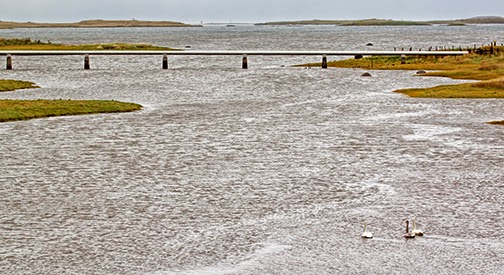
A family of Whooper Swans, Cygnus cygnus,, is peacefully foraging by the edges of a long, seemingly shallow fjord.
It is raining but we stop to observe and photograph anyway.

The swan parents immediately turn back and paddle away.

But the youngster seems to have decided otherwise. Ignoring both, the parents and their warning signals, it made a hundred-and-eighty turn and graciously swims towards us rapidly increasing the distance between its parents and self.


It made its mind! No signals or body language shall lure it back!


What can the parents do about such disobedience?

Turning back to catch up with the young they somehow manage to make it clear: 
Enough is enough!

The strategy works and the cygnet, having decided that we are not worth the trouble, turns its back on us and glides away.

Oh, those children!


Trumpeter Swan, Cygnus buccinator
Whooper Swans are large birds - they are the Old World counterparts to the large Trumpeter Swan,  Cygnus buccinator, of North America
The Trumpeter Swan can be identified by the red on its beak.

The photo had been taken in Montana, USA.


Whooper Swan, Cygnus cygnus


And the one with a really large patch of yellow on the beak is the whooper swan. 
(There are other species of swans with yellow on the beak but this one sports the largest amount of yellow of them all.)


Because of their size and morphology, the whooper swans need very large spaces for taking off to the air. they "run" on water for quite a distance before they can lift their heavy bodies up and fly away.
Therefore they need vast bodies of water that offer not only the submerged vegetation but also the space for take-offs.
Iceland's coastal lines offer just that - vast fjords and swamps. 

That's why we are starting to see them everywhere. What a treat. 


After the grey lava fields of Reykjanes, these green pastoral scenes of the west coast are creating an illusion of having traveled hundreds of kilometers to some other, far-away country. 


In fact we are only about 70 km north from Reykjanes.


A flock of noisy geese has landed in a field half a kilometer away. More wildlife!!!! 
Not sure if I am ever going to able to identify them (so far they are) I am shooting a couple of frames anyway. 


Well, long live the marvels of  the digital photography - they are the Greylag geese, Anser anser, the European species and the great-Grand-Daddys of all domesticated geese.

A waterfall, a waterfall!


Little do we know at this point of our trip that this is only one of a million or so waterfalls that we are going to see! 
With all the rain coming from the ocean, water seems to be abundant in this place.


Beautiful Icelandic horses make up for the lack of other large wildlife

All are special - a very old breed hardly changed over the course of the last millenium.
Their legs are a bit shorter than those of "normal" horses (who wants to be tall in all this wind?). Their genes are actually carefully guarded by the breeders. Also, they are protected from the import of diseases by strict rules and regulations regarding the travel in or out of the country.


It is windy - VERY windy! And it rains 80% of the time (it is september).
But some brave hearts, admirably, travel by bicycle anyhow. All we can do at our advanced ages is to admire their stamina - and their physical condition.


This is a picturesque part of the country (But what in Iceland isn't?).


Ahh, those icelandic sheep! They are cute in their rich, soft coats. The strands of their wool are fluffed up by the never ceasing wind. They are not too keen on close contact with people (at least that was our case) and as soon as we stop to photograph them they move to a safer distance.


Past the city of Borgarnes, is a volcanic rift that hosts a neat crater with a neat name. 
It is Eldborg - translated as Fire Castle. It is a perfectly rounded crater that had been formed some 5 to 8 thousand years ago.
We are stopping to explore the area for a while - there is no need to repeat that the wind is knocking us over, so powerful it is. But the area is astonishingly beautiful (unlike the much younger Reykjanes, this one is already dressed in vegetation). 


There is no need to repeat what a photo of a sign tells the visitors:


Unfortunately we do not have an extra hour in the itinerary for the day therefore we must continue without the hike. 


Here one can rent horses and enjoy the country on the horseback. Those who, like I, admire any horse but view it with some primeval fear and respect can simply walk to the crater by foot. 

I simply admire the colours of the lonesome farm.


A couple more photos and we are off to the main destination of the day - the Snaefellness Peninsula.


Saturday, 7 March 2015

Iceland: From Reykjavik to Snaefellnes Peninsula - AKRANES


West coast of Iceland is much different from the lava mountains of Reykjanes peninsula. Surely, there are still the rocky shores so unfriendly to the marine traffic. Yet, the mountains seem to have stepped back giving space to green pastures and even some farmland. 

But to get there we have to endure a 5.3 km tunnel under a fjord. It is a kind of interesting drive as long as one does not suffer from claustrophobia. What better way to take the mind off than to shoot some photos from the moving car? 
Great fun and before one knows it ....there is the exit and a toll booth on the other side.

The fee isn't steep at all.


For reasons unknown - just because - we chose Akranes as our overnight destination.  
Never been there, that's why!


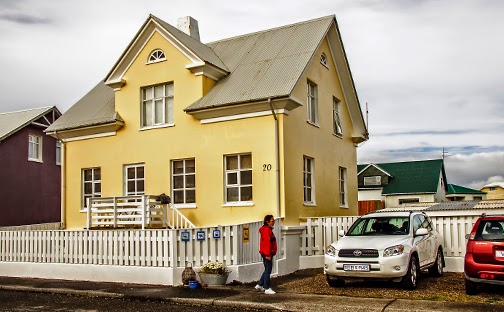
And there it is! Our home away from home - the B&B that Stan booked online. 
The Little Guesthouse by the Ocean 
(Litla gistihúsið við sjóinn)

Not only that - thanks to his diligent planning and to the Google maps we easily found the place. 
Did they expect us? You bet!


We get 2 rooms, a kitchenette and a bathroom.  
And a warning: "Watch out, water is VERY hot! " Geothermal of course.

Also: "This is a fishing town and if you smell fish, it is the smell of money." 
And that is that. 
Later on we shall learn that there is also an aluminum smelting plant nearby and that the town will probably keep on growing because of the industry. Fishing, however is number one.


The town skirts the ocean - or is it the other way? 
A high, man-made wall of hefty stones spans from here to the end of town to protect it from the hungry waves. It is hard to imagine the amount of work that had to be done - not only here but in every town we've seen so far. 
The ocean and the humanity; trying to outdo each other in a never ending struggle.


Having bought some food on the way to Akranes we are opting for a "home made" dinner and a subsequent stroll through the town. 


As always, everything is clean and spacious. 
But save for our friendly hostess and a few people leaving the local church we might begin to believe that Akranes is an alien-marked town. 
Where are the 6,500 people supposedly inhabiting this place?

Well, it is dinner time and everyone who is not at sea is probably at home preparing a meal. Or they went to Reykjavik, only 45 km south from here.

There are not very many gardens here, and this bunch of lupines, with their backdrop of colorful houses is a definite eye catcher.


"Hey,Sis, a bird!!!" 

Even in my retirement age I get teased by Stan!  

All right Bro - this one is for you!

Though sure that the bird will not leave any time soon, I hastily photograph the species of a migratory owl (Owlus plasticus) that got here just before the winter - all the way from China.


We love Icelandic windows, for anywhere we go they are anything but boring.


A display after a display, most accompanied by the strands of tiny Christmas lights. 

They must look great at night - we wonder what it would be like to spend the entire year here; to experience the white nights of the summer and the darkness of the winter. 

Do the people stay or do they travel south?
So many things to ask.


The cat is also behind the window pane. Just staring as if, it too, like the birds above, were made out of porcelain. 


Of course they travel, they always have!


The morning at our B&B is very good. Ham, cheese, eggs, tomatoes along with a pile of special pancakes and dark Icelandic bread, butter and jam - all designed to keep us going well into the afternoon ours. 

Add juice, coffee and milk and we are good to go.


We are leaving Akranes with memories that will last a long, long while:

The old, long abandoned boat on the wild rocky shore.

The lighthouses on the outskirts of the bay.

And a collection of handbags on the wall of the Litla gistihúsið við sjóinn


Touch and go....touch and go. 

Such are the ways of life.


Friday, 6 March 2015

Iceland: ÞINGVELLIR NATIONAL PARK


So, here we go - ÞINGVELLIR.

Ahh - that strange character? The "Þ"? We believed that those who know pronounce it as "th", we simply switched to a "P" - the raw savages us!


ÞINGVELLIR.is Iceland's National Park and the World's UNESCO Heritage site.Since it is not far from Reykjavik it is easy to reach by car or by a bus and it is an important part of so called "Golden Circle Tour" that takes tourists to the "most interesting" sites of South-West Iceland.


There is no doubt that Pingvellir National Park is of interest to many people: geologists, naturalists, historians and photographers alike.

The park is on the northern edge of Iceland's the largest natural lake named Þingvallavatn 
(vatn = lake).


This is another place in Iceland where one can observe the continental rift and the separating continents first hand - it is even more dramatic and telling than the Bridge Between The Continents south of Keflavik. 
They are only about 50 km apart.It is a part of the same rift but it looks totally different. And as we look at the photo Eurasian plate is to the right and the North American plate to the left. Pretty neat.


When we arrived it was - of course - raining. Hard. 
Who said that a photographer should travel with a clear plastic bad to put over a lens? At least that! And who knew better but completely ignored all of it? Served me right. I lost way too many snaps to the rain drops on the glass.

By the way: this is a really good website to check for those who wish to know the weather forecast: http://en.vedur.is/


A million years from now this trail should be several kilometers wide. 


Below is the photo of the rendering of the people's assembly, the AlÞhing, to illustrate the point. 
It was strange to be there - at a place where people started to come together in the year of 930 - almost 1100 years ago. They came from all over Iceland; bringing their suggestions how to build the country, their joys and grievances, their up and down stories of their every-day lives. The remains of their booths built from turf and stone remain in the area until today. 
The AlÞhing is seen as the first democratic parliament in the world.

The Icelanders kept on meeting here for two weeks every year until 1799. Then there was a 45 year gap in the meetings (politics, what else) but in 1844 the assembly renewed itself - this time in Reykjavik where it resides until this day.

That's why ÞINGVELLIR is so sacred to the country of Iceland and why it is under UNESCO today.


As the plates are separating the flatland that forms the valley floor (seen from the trail) are slowly sinking. It is a snail pace by our human standard - but it is a downward movement nevertheless. 
EVERYTHING is in a constant motion. Here we truly feel the time.

We found this structure nearby the park - not sure - but that's how we imagine people living here so many centuries ago.


It must be nice to be here and have TIME. And NO RAIN. Although the rain can sometime be a good ally for photographers. Still - 
Perhaps we will make it back to this remarkable spot on Earth! One day ....

As one of the photographers in cyberspace have said: 
"The best thing about Iceland? It is going back."