Translate

Tuesday, 14 July 2015

Iceland: GODAFOSS

WATERFALL OF THE GODS.

Goðafoss is a spectacular set of waterfalls in central north Iceland. It is not the largest Icelandic waterfall but it is very pretty and historically significant.

Our aim that day was Husavik - but the falls were just about half way in between ... a little detour from the ring road # 1.


We were surprised to see the fields of ripening wheat and stands of planted trees - someone trying to forest the barren landscape of Iceland.

Surprised? We shoud not have been!


With the tectonic plates drifting away from each other thus ripping Iceland into two this area is, once again, rich in geothermal energy.

That's why we see many greenhouses and fertile fields.


To make it all more interesting a river Skjálfandafljót (you pronounce it if you can) has made its way all the way from the ice caps of the mighty Vatnajökull, the largest glacier in Iceland. 
Oh yes, this river is on its South to North course conquering the interior highlands before reaching the Greenland Sea. 


Skjálfandafljót is known for its waterfalls one of which is Goðafoss -  Waterfall of the Gods.


About 30 meters wide and 12 meters high they are far from the largest but their significance is in their role in the history of Iceland.

The year 1,000 found Iceland without a unifying religion - there were tribes and families worshiping different deities from different corners of the Viking world. There was also Christianity making its way here from the South.
We all know too well about the struggles amongst religions and beliefs and the wars in name of religions.

To avoid such fight the emerging nation decided to choose one official religion that would represent it and its values. Easy to say - but which one?

Here we can reconnect with one of the previous entries in this blog - that of the Þingvellir and the first parliament. There, at the annual convention, Alþingi, attended by ll the Icelanders, the governing body of wise men chose ONE person - the country's law speaker to make the hard decision.
"What are we going to be?"
He, himself a pagan, pondered for a very long time. At the end he chose Christianity - for what reasons, political or otherwise, we do not know.

After the convention at Þingvellir the law-speaker made his way back north to his home-farm. As he passed the falls on Skjálfandafljót River, he unwrapped the statues of his pagan gods and tossed them into the falls.

Godafoss were born.


The sun is hugging the horizon and it is time to continue to Husavik. One last look, a good-bye to the river with an unpronounceable name and we are heading North - all the way to the coast.



Iceland: The North - AKUREYRI


We are headed for Akureyri - the town of nearly 18,000.
We should really call it a city instead of  "town" because it is hailed as Iceland's second most important settlement with the largest shipyard in the country.

Akureyri is located just a proverbial stone throw away from the Arctic Circle, yet, thanks to warmer ocean currents, Akureyri reportedly enjoys bearable weather the year round.


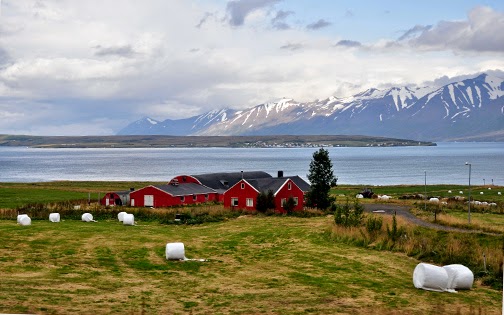
It is settled by the west end of Eyjafjörður, the longest fjord in Iceland and the scenery is beautiful.


Snow-capped mountain ridges reflecting in the cold water and hemmed by the green pastures of early September amount for the unforgettable drive.


And here we are:


The first settlers arrived at the end of the 9th century (890) and it took a long while to establish a trading post in this location. The year was 1602. With trading comes permanent population and by the beginning of the 20th century there were 1,400 permanent residents in Akureyri. 
Things don't happen hastily by the Arctic circle.


Give another century  and Akureyri of 2015 is thriving.
In addition to a University (since 1987), several museums and the botanical gardens there is an interesting downtown with a huge bookstore and many welcoming cafes.
There is also an airport (mostly domestic or to nearby islands including Greenland ).


There are many ways how to get around - one can:
 drive up the hill (like we did)  

walk (like we also did) or  

cycle up the hill (like they do - it hurts just looking at them);  

skateboard down the hill (it hurts too imagining what it would be like for us). 


In any case, this town is worthwhile exploring either way - especially on a nice September day.


We are finding Akureyri to be very artistic; love this pedestrian crossing and the colourful footmarks leading to it.


We are also admiring the wall art - instead of atrocious messages there are true works of art well  worth the look.


Downtown of Akureyri is colourful, clean ad visitor-friendly.

And there are MANY places to visit and explore.


All one has to do is read - and understand!

Isn't this the best part of travel adventures?
It seems that the young lady in the picture came well prepared.


A really elegant place to rest the weary legs and calm the growling stomachs is in the centre of the old town ...very friendly and relaxing. Being a tourist in Akureyri is not bad at all .....


No need for selfies in a town like this!


Yup - we are really, really close - welcome to the Arctic.
There is an interesting medical phenomenon called
Akureyri disease and we wonder if it has anything to do with the darkness of the winter ... though they blame it on poliomyelitis.


Flowers abound in this sub polar city - and though we did not find the church open and did not have time to visit the botanical gardens we had a time to remember for the rest of our days.


Tuesday, 16 June 2015

Iceland: BJARNARHÖFN


Slowly turning our backs on Snaefellnes and its fishing towns we are planning to continue on, to the fjords of the North. But before we manage to leave Snaefellnes for good we are captured by the vast and colourful lava fields of Berserkjahraun. 
Never mind that we are supposed to show in Blonduos for the night!

Like an artist's painting; molded into a bizzare collection of cones and dimples covered by lichens, mosses and ground-hugging plants, the colourful field stretches for miles alongside both sides of our road (# 54). The field is about 3500 years old and it is a site of a famous, hair-rising tale.

The light is beautiful and I wish that we could stay for hours.


The lichens and mosses remind me of the flat bottle of Icelandic Moss Schnapps that we bought last night.

It has been made from a lichen called Iceland Moss, Cetraria islandica....uhhhh..... yes, but it is a lichen OK? And if you collect some of this lichen called Iceland Moss and steep it in alcohol for several weeks you will get a golden liquid that tastes a bit like a really good medicine. 


To find it, one has to visit Vinbudin - the liquor store - and ask for an Icelandic product (most of the stuff has been imported from all over the world.

The clerk will direct you to the back shelving and there it sits, Icelandic Moss Schnapps along with its (much tougher) cousin Brennivin, all modest and waiting to be tried.


.....

We stumbled upon something else in those vast lava fields. It was a shape of a fish known to every person on the planet.
Yes, I am talking about the shark = hákarl in Icelandic.
And those who bravely read my previous posts know that "hákarl" is also the name for that Icelandic national dish of fermented and cured shark meat.
Oh yes! 
The memory of the taste of one tiny cube of hákarl can last a lifetime. But .....


Why would anyone post a statue of a shark in the middle of a deserted lava field? 


The answer is quite simple - we are not far from he sea and someone with a business oriented mind built a small museum in the same location where they process the meat of the captured Greenland sharks, Somniosus microcephalus.

It is just a short side trip from the main road and though we do not plan on eating more hákarl EVER, we want to have a look at the fishing display on site.


In any case - two low buildings just appeared in our view, along with a beautiful waterfall, some horses and an incredible vista of the northern fjords.


Old Farmers' Church, Bjarnarhöfn


Whale vertebrae ...the whale hunting is presently a burning issue between Iceland and EU whose member Iceland is not. 


As a matter of fact, the EUs request that Iceland abndons the whale hunt was a key factor for withdrawing the Iceland's application to EU. 


Family business. 
We have no idea what it takes to make a living at the sea but it looks pretty tough. 


Iceland and the cute Atlantic Puffin, Fratercula arctica (even its Latin name is cute) - the two seem to go hand in hand. In any case - both are native to the arctic sea where puffins spend a lot of their time fishing. They come to the land to nest on the sea adjacent cliffs and when the baby rearing's done they take off to the open waters.

Unfortunately when we arrived to Iceland all the puffins had already gone - flying happily towards Canada, the country we've just left behind.

The only one WE found was in the Bjarnarhöfn museum, serving as a reminder of its tough fate: for ages, puffins and their eggs, had been, and still are, on the peoples' menu . 

So much so that in certain NA regions they all but disappeared.


The other of the two buildings hosts the shark processing plant .... but for that better visit their site.

We need to continue on - leaving the fairy-tale Snaefellnes and head for the north.