Translate

Tuesday, 14 June 2016

THE CHICKEN THIEF: News from Hummingbird Hill Ranch, Mexico

This just arrived from our friends at Hummingbird Hill Ranch that I have written about previously.
With their permission I am just going to paste the letter that Carlos wrote to his Granddaughter Sophie (an 11-year "old" aspiring veterinarian.)

I wish that all of us, Grandparents, shared our experiences with the youngest generation in such way.
So touching!

Here it is:


THE CHICKEN THIEF

Dear Sophie, 
I might have mentioned to you, that some unknown animal was steeling our baby chicks. We started out with 15 babies, and as of today we were left with only 5. How sad!!! We were thinking that this might be a weasel, since we saw her stealing turkey eggs about 2 weeks ago from our turkey hen, when she was making a wild nest in the bamboo bushes.
                So, to protect the baby chicks I built a high mesh fence around the chicken patio. It didn’t help. Another baby chick disappeared. So, I placed a mesh overhead, kind of a wire mesh roof. Unfortunately, I ran out of the mesh wire, so we placed some fabrics over the remaining open area. That seemed to work for a couple of days … until Sunday afternoon.

I was just finishing the sheep food preparation, when I could hear Tisha coming up the fern trail from the old chicken run. 
                “I have a present for you,” I could hear her from behind the bend of the trail.
                I stopped piling up the feed bags and looked in her direction. And there she was, carrying the old, rusty cage we have hanging on a tree as a decoration. In the cage was something big, wild.
                “What is it?” I asked, walking towards her.
                She lifted the cage … and I could see a good size hawk staring at me with his intense, orange eyes.


                “Wow…” is all I could say at first. I have never seem a live hawk from up close, and I could not imagine how Tisha got this fierce bird into the cage.
                “That’s the chicken thief!” she said in a stern voice, and with her finger rattled the cage. The hawk jumped and I though he is going to bite her finger.
                “How did you get him?” I asked incredulously, still non believing what she had.
                “Actually. it wasn’t that hard,” she said. “I was just walking by the chicken house and suddenly I hear a big ruckus. So I ran to the baby chicken area, and there he was. He probably slipped in through the cracks in the fabric, but then could not remember how to get out. He likely flew against the mesh, hit himself and fell to the ground.”
                “Wow … he is quite daring to slip into the chicken aviary," I said.
                “I think that’s the rascal that’s been stealing the chicken, so he is quite confident. But guess what?”


                “No idea,” I said.
                "When I got there, the two mother hens had him in the corner and were trashing him real bad. I guess, if I didn’t come in time, they might have killed. They were really furious.”
                “That’s amaizing,” I said, thinking how brave the hens were. “What are we gona do with him?” I asked.
                “Why don’t we leave him in the cage for couple of hours, as a punishement for stealing the chicken. And then we'll let him go. Maybe he has learned his leson and won’t come back.”
                “How about some photos?” I asked.
                “Good idea.”

After about two hours I brought my camera. We had the cage inside the workshop, so the dogs would not bother him, and also just in case he got away when we were taking him out of the cage.
                Tisha reached into the cage and grabbed him from above, by the back and the wings. She got him out easily.
                “I think we should hold him by the legs for the pictures. I saw that in one documentary. It looks realy cool.”
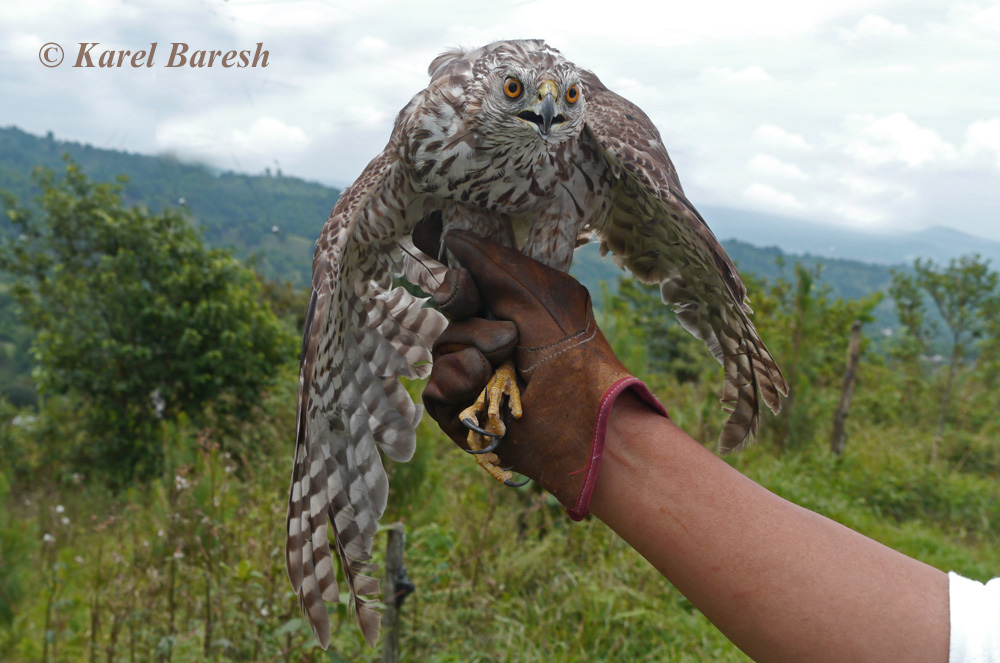


                “Okay," said Tisha, and tipped him sideways, so I could grab the legs. But they were none in site. I guess he hid them under his belly feathers. To see what was going on, I probed around his belly with my index finger. In a flash one leg shot out, and as my finger came into contact with the sensitive under-pad of his foot, an automatic reaction happened.         
He grabbed my finger with his fingers, very tightly I may say, and before I could react, his razor sharp talons penetrated my finger. All four of them. The talons are about one and half centimeters long, so they went through my index finger very easily, and were sticking out on the other sides of the finger.
                “Ouch!” I yelled and jerked my hand.


                A wrong move. The jerking motion triggered another reaction and the grip tightened even more. With my free hand I tried to loosen one of the claws. Almost impossible. The grip was so strong, and the claws were curved, so to extract them called for special technique.
                If I tell you that it took us more than five painful minutes to extract the claws from my finger, and that at one point he got Tisha with his other foot, I am not exaggerating. For a minute, while we were both impaled by his claws, we thought we will never get out of his grip. But then, little by little, we got free.


                The photo shoot went well and the hawk was modeling his best fierce, frightening poses. When we let him go, he took off and flew as far away from the ranch as he could. Let’s hope he doesn’t come back. But, for a good measure, I found some old mesh and plugged up the remaining holes.

Certainly a very powerful, smart and dangerous bird, but also very beautiful. And just a small advice for the future: if you are handling hawks, make sure you have strong leather gloves and don’t touch the feet :NO!

Saludos y amor,

Carlos, Tisha and the Hawk


2 days later

PS:
Bonnie and Charles just sent this photo and according to them it is a juvenile Great Black Hawk. So, in my description of the three, this one and the big dark one are perhaps the same, only this guy is a juvenile.
I wonder what would have happened if my finger was grabbed by the daddy hawk!
Love,
CB

PS 
The swelling is coming down and I can bend the finger again.


 Hummingbird Hill Ranch by Carlos Leonardo Baresh 

Saturday, 30 April 2016

LET IT BE!...LET IT BE!...LET IT BE!


A while ago I posted this photo of our night-time visitor, the Striped Skunk (Mephitis mephitis). It was eating seeds left over by the birds.  It also gave me a good scare the night before and made me run the fastest 200m dash since my athletic times million years ago.

The moon was full and bright and there was a very light layer of fog gently hovering just about the grassy lawn. It was strangely beautiful fog, only about one to two meters thick allowing me to wade through it with my torso floating above it, all illuminated by the full moon. The fog swayed gently but mostly, everything was quiet and peaceful as if there was not  a single worry in the entire world.
Nights like that do not happen often and when they do it is impossible to stay inside the house. For me at  least...


Such nights always drag me out of the bed, in my night gown (no we do not live in a city), and take me, like a White Lady for a walkabout in the silver light. We live on three acres of rural land.
I was at peace with everyone and everything I could think of; walking from tree to tree, telling them quietly how beautiful they were. Just then I noticed a white piece of paper underneath that translucent silvery fog. 
Ah, people! Why can't they just keep their trash in their own space? I started forward to pick it up and almost did so when, suddenly, it moved!
Huh?
The air was still, not the slightest breeze disturbed my surroundings. My feet somewhere down under the fog came to a stop.
But the paper kept on moving; TOWARDS me! Only then did I notice the dark shadow that was outlining the white.
My brain took two more seconds to register! A skunk!
Three meters away and coming closer!
I whispered something. 
Maybe "hi handsome" or "wow, you fooled me" ....in any case it wasn't offensive and definitely not loud.
The skunk seemed to like it because it kept on moving closer. 
"No, no, no," I said, my feet down there finally starting to back up. 
.....

"No, no!  YOU go THAT way, okay?"

More I tried to shuffle backwards more enthusiastically the skunk advanced. Maybe it liked my shiny-white sneakers moving in the fog. Maybe it was a social creature and needed company. Or maybe it had rabies. 
It was hard to tell.

It all ended up by me taking a mad dash across the two-acre property with the skunk happily trundling behind. Emerging from the fog I cleared the front steps by two at a time, dove into the dark safety of the house and locked the door behind me. 
Silly, I know. 

But it was memorable nevertheless.

A couple years later I met another one - in the morning. No self respecting skunk works during the day! But this one did. Probably a hungry teenager still having to learn a lot about the world.


It was interesting to watch it digging in the dirt, pulling out fat larvae and enjoying the feast. 
That was it! That's why the lawn often looks like someone ran a semi-automatic across it.


Heavy digging was rewarded with a healthy snack. Large fat beetle larvae live underneath the surface, feeding on grass roots all year long. They are active at night; that's when they come closer to the surface (and that's why the skunks hunt mostly at night).
The would-be ground beetle would never see the world in its adult form - not that one anyway. 


Who else might fall a victim to the skunks nightly escapade? Mostly insects but also frogs, worms and earthworms, snails and slugs .... any protein small enough to tackle will do. But fruits and berries, seeds and fungi will do also. Skunk is an omnivore.


Mephitis mephitis. Those words should serve as dire warning. Mephitis means stinky,.
Really, really stinky!

The skunk is like a living weapon equipped with a double barrel positioned right by its rear end. There are two glands underneath its tail that make a weekly supply of very, very, VERY foul smelling gunky, putrid, noxious liquid that can deter most enemies. (Add your own adjectives.) Bad!
And the skunk is also a very accurate shooter! Not only that, it shoots with its head facing in the opposite direction - MOVE OVER Dirty Harry! It can get you with its eyes closed and as far as four meters away!
So ... really ... MOVE.
I certainly did when this one turned its barrels at me - nobody wants to be on the wrong side of this creature!

Mephitis mephitis. How suitable.


Thanks to its rear end charges, skunk does not have to worry about too many predators. I don't think that any creature will try more than once. Bobcat perhaps. 


But they say that Great-horned Owl will take a skunk for dinner. 

A question arises then: do owls have a sense of smell?


Wednesday, 13 April 2016

NATURE'S BLUES

It is April.
Again!

In British Columbia April means Spring. 
And Spring means that the birds are back! 
They come in drones from their vacation homes "down south". 
Or is it that their vacation homes are here, "up north"?
Call it what you want, they are back and the world seems to be a much happier place.

The first half of April "up here" means, that unlike "down south", most places are still only modestly green or even beige and brown. 
Some are even white! 
But then a dash of the most attractive blue cuts through the landscape!

Bluebirds have arrived!


There are 3 kinds of bluebirds in Canada and 2 of them, the Mountain and the Western live in British Columbia. The third one, the Eastern bluebird, has not conquered the Rockies yet, it can be found in the Eastern part of North America. 

The one above is  Mountain bluebird (Sialia currucoides).

And, below is a pair - Mom and Dad. 
Actually, there was only one mullein plant there and they took turns perching on it for a better view while hunting for insects. Thanks to Adobe Photoshop the 2 images got stitched into a seamless composition (although color-wise they were a bit different to start with). Just overlap the two, go to Edit, Auto-blend images and choose Panorama. Photoshop adjusted the overall tones as well.


 Here they are again, this time both together at once.

Bluebirds, like many other creatures, were almost wiped out once, courtesy of pesticides and other man-made niceties. 
Mountain bluebirds like treed areas with natural nesting cavities. With their habitat disappearing at the fast rate the bluebird species nearly followed the suit.
Thankfully people realized how close was the race to oblivion and began to put up the nesting boxes.
The bluebirds accepted the alternative.


They are quite territorial and willing to defend their home. 

Still, there are other species such as tree swallows, sparrows and starlings (oh, yes!) willing to oust the bluebirds out of the nesting box or a tree cavity. Despite of that, the bluebirds are making a comeback.

I spent several hours trying to take photos of this couple. I tried not to get too close, and since I did not have a blind, I left my camera on a tripod with the long lens aimed and focused on one spot.
Then, remote in hand, I sat far away from the location (my remote will fire the camera a couple hundred meters away) hoping that the bird would show up in the place I chose. 

Seems crazy but it works - at times.
.It is usually  combination of observation and luck, and if you are short on patience don't try!


Anyhow, "my" bluebird was cooperating for a long while; as long as I was far away it did not mind the lens at all. 

Perched on its fence post it searched for bugs, crickets, cicadas, spiders .... no-one was safe. Mom was on the nest and it looked like Dad was feeding them both. 

And I stayed focused! 

Just when I was ready to pat myself on the back for the work well done, "my" bluebird disappeared. It left the post on my left, took a low-curved path right in front of me and did not return for a long time. 
Finally, restless, I looked around - the bird sat perched on a fence post right behind my right shoulder.
Giving the unfaithful bird a piece of my mind I started to collect my stiff body so I could finally retrieve the camera and tripod from the location on the left.


As I straightened up my aching knees I made an eye contact with something much larger than a bird!


Thankfully the bear got as scared as I, turned back and walked away. 
It must have been there for a while; obscured by bushes and grass, peacefully exploring the ditch on my right. 
Where there is a bear there are bugs and the bluebird knew it. It was almost like the food-home-delivery for it, until I spooked the bear. 
I could see both of them, the big dark one, and the shiny-blue little one, working together for a while until they both disappeared behind the bush.

Who said that one cannot learn from the birds?

In another field  another couple  took up a residence. They were cousins to the mountain bluebirds but as far as I could tell, that's where the relationship ended. 
A pair of Western Bluebirds  (Sialia mexicana) decided to raise their family. 
For that, they chose the nest box 35.

Western Bluebirds are not as widely spread as their Mountain Bluebird relatives. They barely clear the border of Southern BC, prefering the western side of USA and Mexico. 
They also prefer lower elevations and more open spaces. But once in a while their territories overlap.


I photographed the two above in the Palouse area (N. Washington State, USA) about 5 years ago. 
The other photos were taken "just across the border" in Southern Interior of British Columbia where Pend Oreille River meets the mighty Columbia


By the time I discovered them, they were a very busy couple: both constantly flying in and out, delivering crickets, cicadas, fat caterpillars, spiders, large flying bugs, you name it....

On her way out the female often carried white baby poop to discard it far away from the nest and to keep the premise clean.

Once in a while they met on the top of the nest box as if to communicate about some important next steps.


All seemed well for a couple of days but then I noticed a brewing trouble. 
It was a pair of cute Tree Swallows seemingly quite determined to chase the bluebirds out of the area. They would not attack the bluebirds physically but bullied them enough to make them uncomfortable. The male bluebird would have to take after the bickering swallows just to have them come back a short while later and bicker some more. Annoying!

I did not make it back to the location for a week. But when I did, the bluebirds were gone and the swallow couple was refurbishing the nest box 35. 
It looked like they managed to harass the bluebirds enough to make them leave the nest.
.
I'll sing and protect, you build. OK?
Hard work, this family business! Where is HE, anyway?

.


What happened to the young bluebird family? I have no idea. I found the male perched on a fence post half a mile away. No female, no juvenile bluebirds. 
And since I would not go near the nest box the end of this Nature story is anyone's guess.

For more information about the bluebirds (and other wildlife) in the West Kootenay area check the following site:Dan Reibin, Birds 2015.

Saturday, 19 March 2016

HAPPY EARTH DAY, EVERYONE: A Message From My Grandchildren

Lets stop fighting and start living; there is only ONE EARTH we can live on.


Lets live and lead by teaching kindness, not greed and power.


Lets share the road of life with others. 


Lets keep their
and our homes
undisturbed and clean.

We can all try,
a bit by bit.

By wanting less
we will get so much more.


 HAPPY EARTH DAY EVERYONE.


Wednesday, 16 March 2016

Mexico: ALVARADO - Ode To The (Brown) Pelican


A funny old bird is a pelican.
His beak can hold more than his belican.
Food for a week
He can hold in his beak,
But I don't know how the helican.


I am NOT cleaning! YOU got the food, YOU do it!

Yo, Bro! They say that we are living fossils! Talking about 30 million years ago or something.
Would you take a guess where they got an idea like that?

As far as I am concerned I was born a year ago.

Hear me?
... Guess not.


By the way ....how's that fish?


Come on buddy, start chopping - I am not above the handouts!

On the contrary.


A juvenile and an adult brown pelican. The adult has a white head, often with a yellowish tinge as the bird gets older.

There are 8 species of pelicans, most of them white and only two are brown; one is the Peruvian pelican and the other, the brown pelican of Mexico. It seems to be numerous nowadays but not so long ago it had been almost wiped out by pesticides, chiefly by the notorious DDT.
Their North American cousin is the white pelican and the two species hardly ever mix. There are sporadic times during  El Nino  times when the fish and other oceanic animals are moving up the Pacific coast of NA. In order not to face starvation, the brown pelicans must follow. 
(Perhaps if we built a wall they would stay in Mexico.....sorry, could not help it.)
With the exception of polar regions the pelicans of different species can be found on every continent. 
And while the brown pelicans dive straight down to catch their sushi, the other species have developed different fishing techniques. 


As we found out in the fish market of Alvarado (and elsewhere) the browns are quite fond of their free meals. 

Fisherman accommodate them well and if you ask, respectfully, they will accommodate you, and your camera as well. 


In Alvarado,Veracruz, Mexico everyone can along just fine.


The Coast Guard Squad!!! Sunrise on the coast of Veracruz

At attention and ready to take off. Fish beware!


Wednesday, 2 March 2016

Mexico: XICO


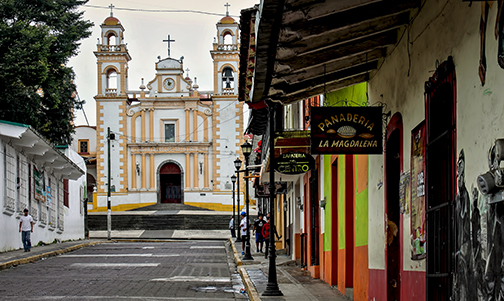
I promised to say something about Xico. Not that I am an expert of any kind but we were lucky enough to spend some time in this "Pueblo Magico", the old colonial town set in the lush mountains of Veracruz.


It truly is a beautiful place with cobbled streets, old terracotta roofs and an ancient feel. 

The name "Xico" might sound strange to most, but here is what I found on the following  website!
http://www.mexconnect.com/articles/1525-xico-a-village-of-enchantment-in-veracruz  :

"Founded in the year 1313, Xico’s original name was Xico-Chimalco in the Náhuatl (Aztec) language meaning "where there are bee hives of yellow wax...."

And if you checked out my previous blog you may have noticed that that too is about the bees.
Now I am really proud!

As Carlos Baresh described it in his book, Xico has 4 main streets running up the hill (or down if you please). On the upper end there is a  beautiful church dedicated to Mary Magdalene, a chapel (Capilla de Cristo Rey) that is beautifully decorated with blue tiles and Xico Velho (Old Xico) which is a gateway to the hills of Cofre de Perote.  The low end of Xico sports an arched gate with a hearty "Welcome to Xico".

The streets are mostly one-way traffic - two and two, but if you are as good as we were, you will get lost anyway.


About 8 km away from a larger city, Coatepec, and 25 km from Xalapa (capital city of the state), Xico is surrounded by coffee plantations and cattle ranches.


This flower shop must be doing really well, for there are always reasons to celebrate and offer flowers. As far as we understood the main holidays holidays and festivities include:
The Mary Magdalene Celebrations 
(July 17th to 23rd).and
The Xiqueñada on July 22nd featuring running of the bulls. Something like Spain's encierro in Pomplona but, I imagine, on a much smaller scale.


Maria Magdalena parish Church, Xico

Then there is Day of the Dead, Christmas, Easter and many others. 


It is not up to me to describe many local holidays and celebrations that take place in Xico throughout the year. We spent too little time there to be able to talk about that. But even in our short month it became clear that there is something happening there all the time.


When we got there it was after the Day of the dead "Dia de Muertos". 
Although the pre-Spanish cultures observed this holiday of the dead at the beginning of the summer, it, like many other holidays of the Christian era, shifted to more suitable dates.
This one to October 31 to November 2nd, thus coinciding with All Saints Day. 

We arrived to Xico at the end of November therefore the only reminder of Dia de Muertos (or Dia de Los Muertes) to us, were the decorations on the upper floor of the local cafe.


We grew up with the All Saint's Day and/or All Soul's Day - to us a somber and  serious day to honor those who left us behind. For us it meant a trip to a cemetery, decorating the graves with flowers, lighting candles, sharing the memories and shedding tears. November first was usually cloudy, foggy or rainy and cold to the bone.  Yet, the old cemeteries, all aglow in flickering candle light were quite soul touching and mysterious. 
Death was a serious matter.

Then, in North America, we learned to participate in Halloween. I must admit that though Halloween is fun, it never managed to replace the remembrances of the All Soul's Day. Perhaps, growing up with that and arriving to North America well into our adult years, it was too late for us to learn to truly embrace Halloween. 
Ask our kids about this topic and their answer will be entirely different.

And now - the Mexican Dia de Muertos! 
While Halloween is spooky and playing on fear, the Day Of the Dead is the heart touching time with, still another, twist. 
It seemed to us that, instead of installing sadness and fear, it managed to embrace death as an essential part of life.

Interesting how many thoughts can run through ones mind in a small cafe of an ancient town of Xico.

A painting on the wall served as a reminder of yet another holiday and a local tradition, the Xiqueñada, the running of the bulls. That too, we have been told, is a big deal in this town.


"Dia de Muertos" was just past and the bull fights would happen in July. 
But it was the beginning of December and everything in town was already gearing up for Christmas.


With Christmas was still some three weeks ahead. Yet, one day  a large crowd of people gathered on the steps of the Capilla de Cristo Rey. 


Capilla de Cristo Rey

"What's going on?"
"Ah, they are going to decorate the chapel."

Surely enough, two days after, the chapel was handsomely decorated with palm ornaments and flowers.
Marigolds, as our hosts told us, are the flowers of the dead.
But people bring many other flowers as well, namely the orchids that grow up in the mountains of Cofre de Perote.


And that could become a problem.

Along with deforestation the places of the amazing orchids of Veracruz are shrinking.
There are about 3 000 orchid species found in this part of the world. Lets hope that it will remain this way.


And, gearing for Christmas they were!
Perhaps it was another celebration of a kind we do not understand. For the celebrations in so many conquered countries always involve a mix of old and new. A mix of ancient customs, traditions and beliefs and Christian religion.


People from the surrounding hills
descended on Xico just about 10 days before Christmas.
They brought down - not always by a motorized vehicles but often carried on foot - these large structures. 


The sticks are fireworks and the inner middle part fits on a person's back. 

In an evening celebration men carry them while the fireworks are lit.
We learned from Carlos, that the dancer-carriers often suffer serious burns.


A couple days after the event we happened to drive from Xico up to the slopes of Cofre de Perote. We were passing groups of young men who were hauling the heavy structures back to their villages.
That, we thought, is dedication!

The volcanic foothills of Cofre de Perote are steep but, out of necessity, many villagers think nothing of hiking down to Xico and back. It was somewhere here, 10 - 15 kilometers from Xico where we stopped for a group of young men and their heavy firework display construction. They were all but happy to get a several kilometer ride in Carlos's Nissan truck. 
Kudos to the truck!!!


Xico has several restaurants and cafes, and their hospitality and quality is well expressed by the chef (or the depiction of) of this establishment.

It is also well known for its home-made moles (sauces) and above all for its local, fragrant and great tasting organic coffee. 
There is a large number of coffee plantations all around Xico.
But a trip to a coffee plantation would be another story.


There is a nice video to watch - click on the link and at the top right corner is a short presentation that is worth while watching.